Photographing the West Front of Notre-Dame de Fourvière in Lyon: When You Can't Fix the Verticals, Commit to the Tilt
There is no good place to stand in front of Notre-Dame de Fourvière. The parvis is shallow, the hill falls away behind you, and the façade is enormous. You back up until you run out of ground, and you’re still looking almost straight up. Every wide shot of this building has converging verticals in it. The only real decision is whether you pretend otherwise.
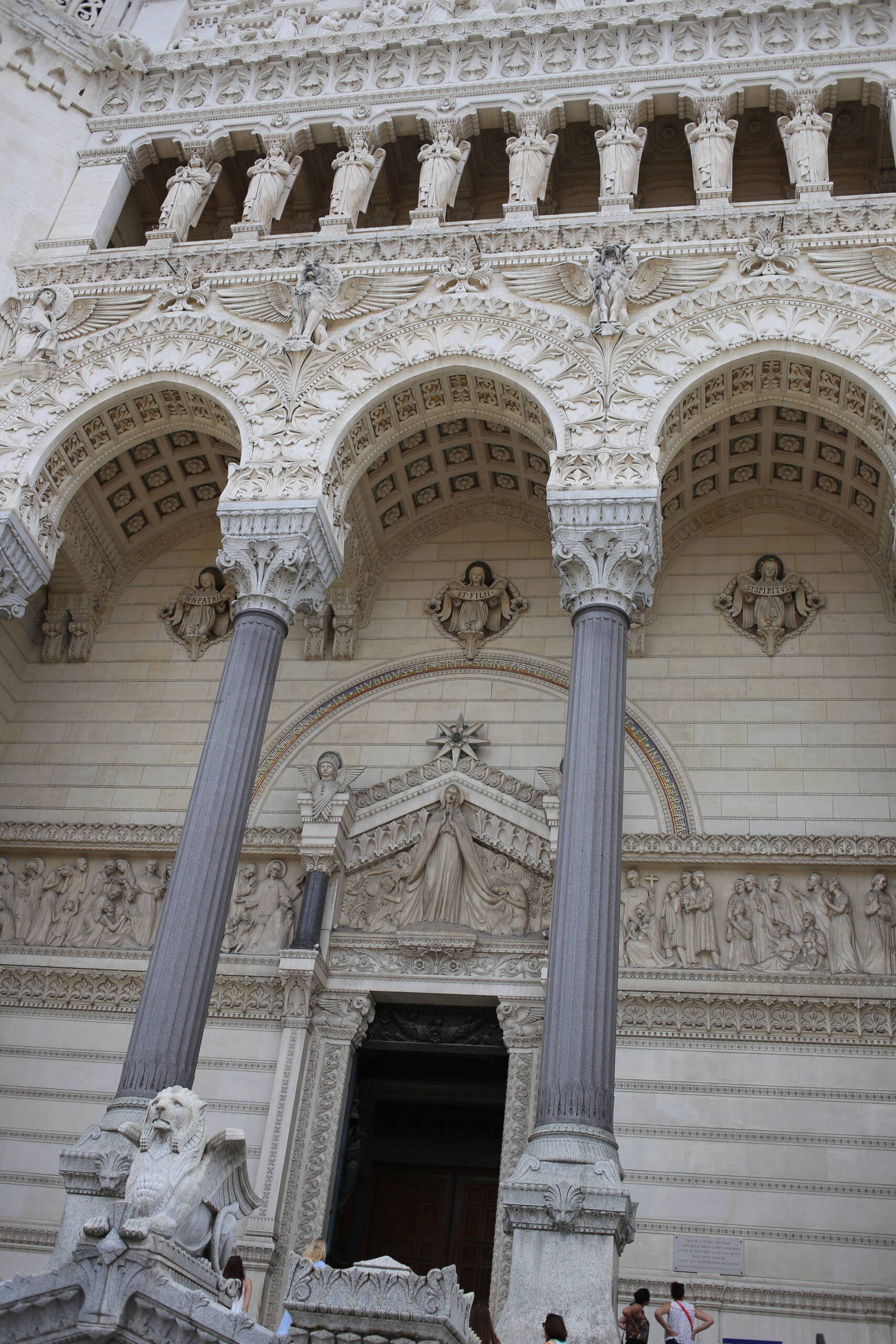
I decided not to pretend. This is shot upward from the stairs, portrait orientation, sky cropped out entirely, and the lean is left in. Half-correcting a tilt this steep gives you the worst of both: the building still looks like it’s falling over, and now the top corners are stretched and soft from the transform. Either shoot it flat from a distance you don’t have, or lean into the geometry and let the columns run diagonally out of the frame.
What’s in the frame
Pierre Bossan designed this. Ground broken in 1872, last stone in 1884, consecrated in 1896. It came out of a vow made during the Franco-Prussian War: if Lyon were spared, the city would build a church for the Virgin. The Prussians stopped short. Lyon paid up.
Working from the top of my frame down:
The row of standing figures under the pediment is the gallery of caryatid angels, carved by Paul-Émile Millefaut. They carry swords, and they carry the pediment. Bossan wanted a fortress and Millefaut built him columns that look like a garrison. The open gallery behind them is structural cleverness, lightening a wall that would otherwise be a solid mass.
In the spandrels above the three arches, the winged figures are the tetramorph, the four evangelist symbols. Eagle, lion, ox, winged man, running across the front.
The three medallions tucked under the arches are angels holding scrolls, and the scrolls carry the baptismal formula in Latin, one clause per arch. In the name of the Father, and of the Son, and of the Holy Spirit. Read the façade left to right and you’ve read the Trinity.
Down at the bottom left, the winged lion on the parapet guards the way into the crypt, which is dedicated to Joseph. Bossan’s idea was that you reach Mary through Joseph, dark church below, bright one above.
And the two grey granite shafts are doing all the visual work. Everything else here is white limestone carved to within an inch of its life. The columns are the only large plain surfaces in the composition, and they’re a different material and a different colour. Without them the frame collapses into texture soup.
The exposure
Bright hazy sun on near-white stone. Meter off the limestone and your camera will try to drag it to mid grey, which flattens the relief and turns the deep carving into mud.
Overexpose relative to the meter, watch the highlight warning on the brightest sunlit edges of the pediment, and back off just enough that those edges keep detail. Everything else follows. The shadowed coffering inside the arches will sit two or three stops down, which is correct. Those recesses should read as dark.
Do not lift the shadows much in post. The whole effect of this façade is depth cut into a flat white wall, and the depth is shadow. Lift it and you flatten the building.
Framing choices that mattered
Crop the sky out. Sky next to white stone in bright light is a fight you lose, and the building is more impressive when it has no top edge and appears to keep going.
Put the columns off centre. They’re at roughly the thirds, which leaves the central arch and the tympanum sitting in the middle where the eye lands. Dead centring the whole façade needs a step back that doesn’t exist.
Leave the people in. The four heads along the bottom edge are the only scale reference in the picture. Without them the reader has no idea whether the arches are three metres tall or twelve.
Shoot it late morning. The front faces roughly east over the city, so the carving gets raking light early and goes flat and shadeless by afternoon. This one is later than ideal, honestly. The relief above the doorway has less bite than it would at nine.
If you’re going up, go early, take something in the 24 to 35 range for the whole front, and take something longer for the caryatids. They’re worth their own frame.