How the Triptych Outlived the Altarpiece, From Bosch to Bacon to the Documentary Frame
Three frames from a protest, stacked one above the other. No hinges, no gold, no saints, nothing devotional anywhere in it. It still reads as a triptych, and the reason has almost nothing to do with the subject and everything to do with what the format asks the viewer to do.
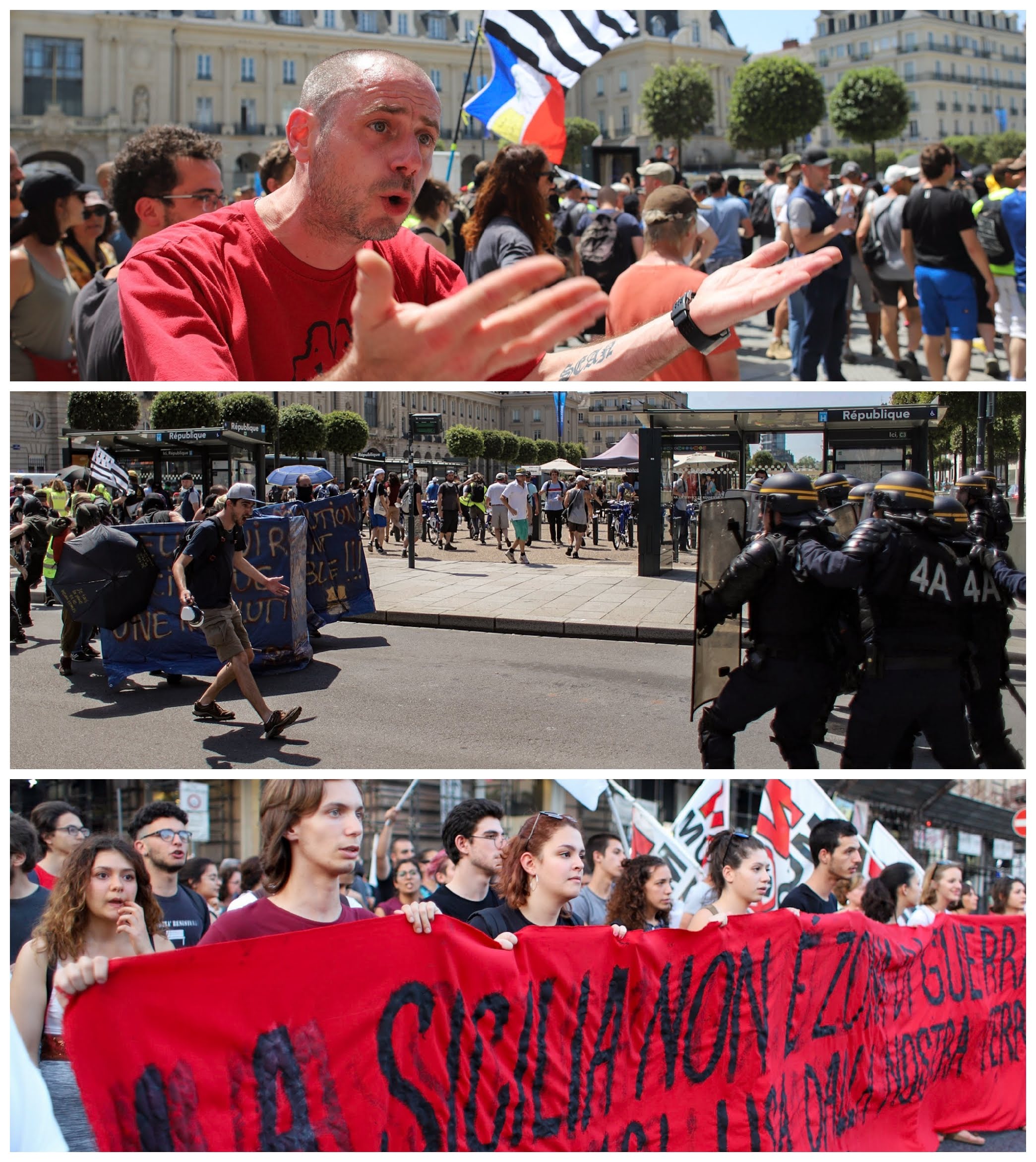
A single picture asks you to look. Three panels ask you to compare. That sounds like a small difference. It is the whole engine of the form.
The hinge did the thinking
The triptych started as furniture before it was a genre. Early Christian ivories and small Byzantine devotional objects folded shut so they could be carried, and the wings protected the painted interior in transit. By the fifteenth century in the Netherlands and Germany the same logic had scaled up into altarpieces with movable wings, and the practical feature had turned into a liturgical one. The work was kept closed through ordinary time and opened for feasts, which means it had states. A painting with states has duration built into it, and duration is normally the privilege of music or theatre.
The closed exterior was usually painted in grisaille, grey monochrome imitating carved stone. Bosch put the world on the third day of creation on the outside of the Garden of Earthly Delights, a flat grey globe under a thin sky, so that opening the wings performed the arrival of colour and appetite and ruin. Grünewald’s Isenheim altarpiece at Colmar goes further and has more than one opening, so the crucifixion gives way to the annunciation and resurrection depending on the day. The audience did not see a picture. They saw a machine being operated on their behalf.
The internal hierarchy was just as fixed. The centre panel took the sacred event, the wings took the approach to it, and the donors who paid for the thing knelt in the wings at a respectful angle, permanently attending something they were not quite inside. Scale did the ranking. Position did the theology.
What survived the Reformation
When altarpieces stopped being commissioned at volume in the Protestant north, the triptych should have died with its function. What happened instead is that the format got detached from the belief and stayed available as a source of borrowed authority.
Otto Dix painted his war triptych in Dresden around 1930 in deliberate Renaissance form, predella and all, and used the sanctity of the arrangement against its own tradition. The dead in the trenches occupy the position where a resurrection belongs. Max Beckmann built a run of large triptychs through the 1930s and after, with the centre panel holding some departure or escape and the wings holding torture and confinement, which is medieval structure carrying twentieth-century politics without a single religious figure in it.
Francis Bacon took the form somewhere colder. From the 1944 studies for figures at the base of a crucifixion onward he worked in threes throughout his career, and he was strict about the presentation: separate frames, separate glass, panels that must never be allowed to flow into one another as a continuous scene. The gaps are the point. His figures cannot reach each other, and the viewer’s eye has to jump a physical border to complete a comparison that never quite resolves. A triptych by Bacon is closer to a police lineup than to a narrative.
Two gaps, three reads
Strip away the history and the mechanics are simple enough to use.
Three panels give you two gaps, and those gaps are where the viewer works. Put a strong hierarchy in place, with a dominant centre and two subordinate wings, and the reading becomes devotional in shape even if the content is secular. Give the panels equal weight and the eye starts running left to right, or top to bottom, and the reading becomes temporal. The same three images can behave as a single moment held open or as a sequence unfolding, depending only on how you weight and order them.
Orientation matters more than people expect. Horizontal panels inherit the altarpiece and the frieze, so they tend to read as one world extended sideways. A vertical stack inherits the film strip and the contact sheet, so it tends to read as time. The protest sequence above is stacked, and stacked is why it feels like a progression from argument to confrontation to organised procession rather than a single square seen through three windows.
And there is a reason four panels feel different. Four splits cleanly into pairs and invites symmetry. Three refuses to divide, so one panel always ends up mediating between the other two, and the viewer has to decide which one is doing the mediating. That decision is the work of looking, handed over to the audience.
The wings closed on a religion five centuries ago. The mechanism stayed open.