Burgos, De Chirico and Antonio López: How the Empty Street Became a Subject
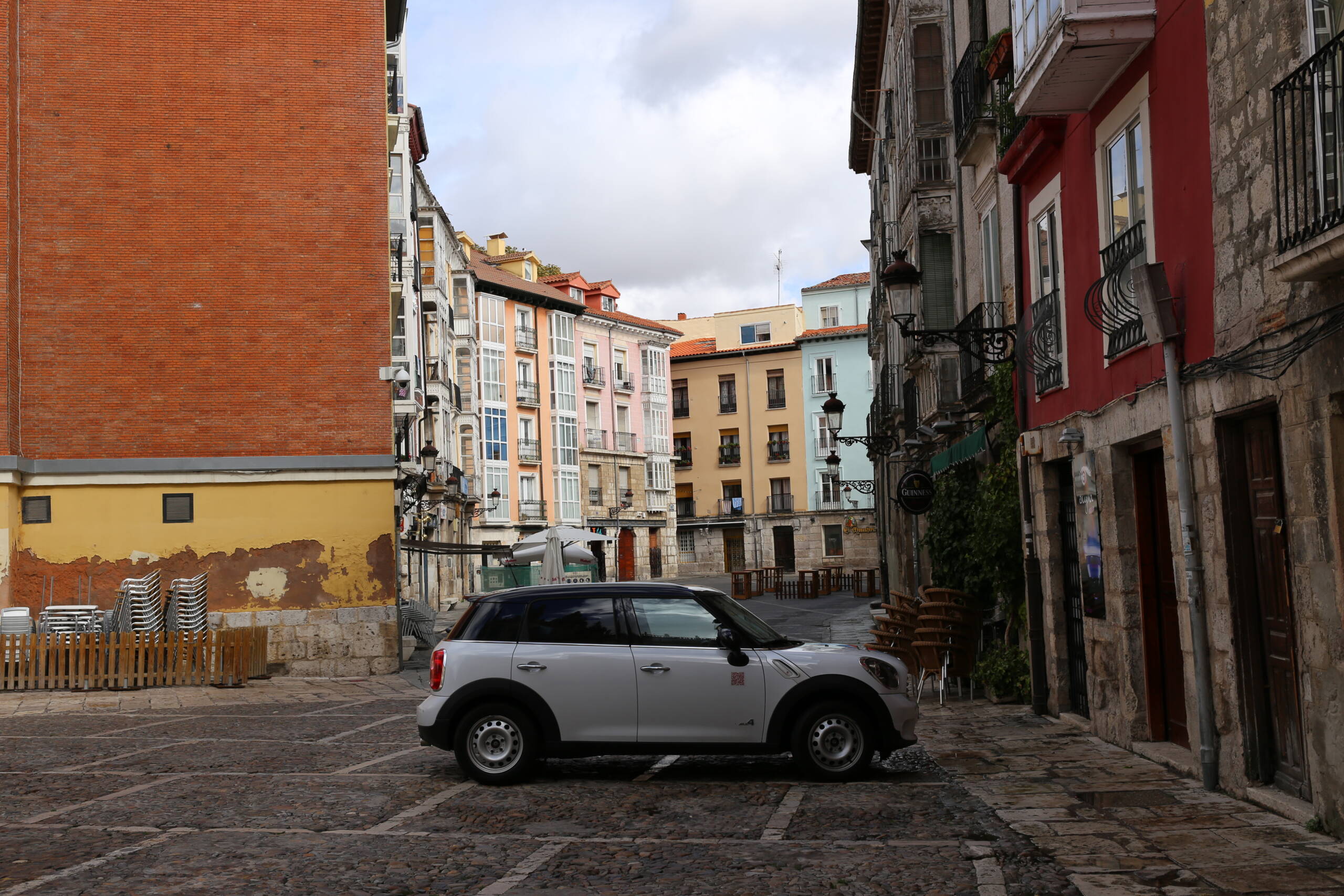
A cobbled slope in Burgos, somewhere in the lanes below the cathedral. Stacked café chairs behind a low fence on the left. A furled umbrella out in the middle distance. One white Mini parked across the frame like it was left there by accident. Flat overcast, no shadows worth the name, and not a single person in a picture that contains perhaps two hundred windows.
Painters spent most of European history treating a street as a container for events. Processions, markets, riots, weather. The street itself was the setting and something else was the subject. Then at some point in the early twentieth century the container became the thing, and emptiness stopped being a failure of the composition.
Giorgio de Chirico is usually where that turn gets dated. The Piazza d’Italia paintings he started around 1913 are all arcade, shadow and vacancy, with the human presence reduced to a statue or a tiny figure walking out of frame. He was not painting loneliness. He was painting the strangeness that arrives when familiar architecture is stripped of the crowd that explains it. Take the people out of a square and the square starts looking like it was built for reasons nobody remembers.
Spain took the idea somewhere slower
The Spanish version is less theatrical and much more patient. Antonio López García has been painting Madrid this way since the 1960s, most famously the Gran Vía, which he worked on at dawn across years, returning at the same hour so the light would match. The result is a major thoroughfare with almost nobody in it, rendered with an exactness that gets close to photography and then refuses it.
What López understood is that the empty street is not an absence, it is a delay. Everyone is about to arrive. The chairs are stacked because they will be unstacked at eleven. The umbrella is furled because someone will open it. A city photographed or painted between shifts is a city showing you its structure, the way a stage looks before the actors come out.
That is the register this Burgos frame sits in. Nothing has gone wrong here. It is just the hour before the bar sets up.
The miradores do the work
There is one element in this picture that a de Chirico piazza never had, and it changes the temperature.
Look at the far side of the little square. Pink, salmon, mint green, ochre, and stacked across all of them the glazed wooden galleries that northern Spain uses instead of open balconies. Miradores. They came in through the nineteenth century, glass and slim timber framing on an industrial supply, and they solved a real problem on this plateau, which is that the sun is good and the wind is not. A glazed box on the front of the flat catches the heat and keeps the weather out.
Their side effect is what matters for a picture. A street lined with miradores is a street lined with mirrors. Every one of them holds a slab of sky, so the façade reads as a lattice of reflected cloud rather than a wall. In this frame the buildings are lit up while the ground is not, and the whole thing tips slightly, as though the top half of the picture is the day and the bottom half is the pause.
An open balcony would have said nobody is home. A glazed one says something else. Somebody could be standing behind that glass right now and you would never know, because all you can see is the weather bouncing back at you.
That is the whole appeal of an empty street. It is never as empty as it looks.